
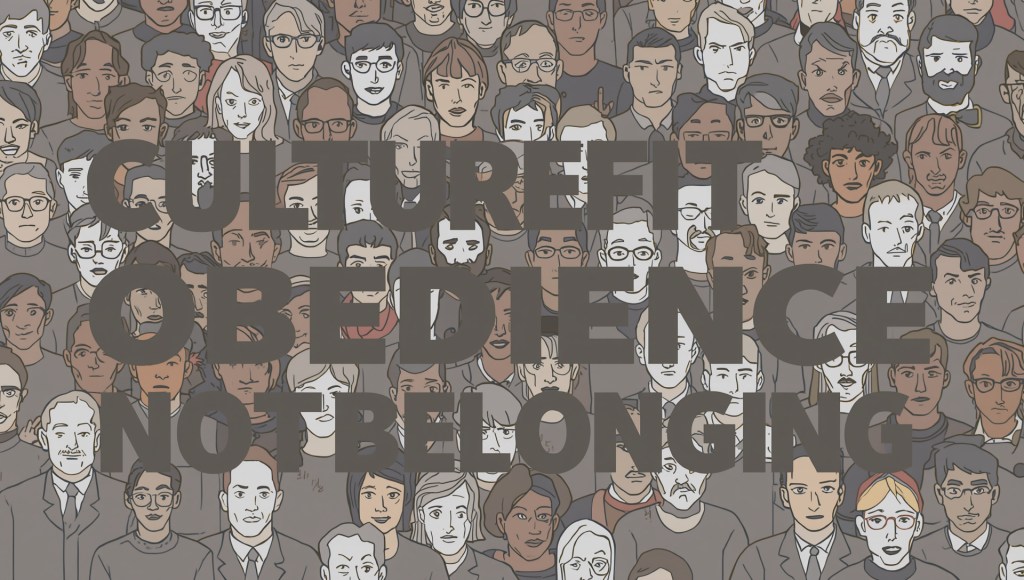
If you have ever been rejected for being “not a culture fit,” you already know how hollow that phrase really is. It is the corporate equivalent of “it’s not you, it’s me.” A vague, noncommittal excuse that says nothing and means everything.
Companies love to parade their culture like it is some priceless artifact. They plaster it across career pages, brag about it in interviews, and weave it into every all hands speech. They act as if culture is their golden ticket, the thing that makes them special. But behind the slogans and stock photos, culture is rarely about inclusion or belonging. It is about control.
What Culture Fit Really Means
When a company says you are “not a fit,” here is what they usually mean:
- You asked too many questions in interviews.
- You challenged the status quo a little too loudly.
- You did not laugh at the boss’s recycled jokes.
- You showed ambition that made someone nervous.
- You were too different to be easy to manage.
Culture fit is not about whether you can do the job. It is about whether you will obey without rocking the boat.
And once you are inside, the test continues. Every meeting becomes a quiet measurement of how well you “align.” Do you nod in agreement even when the plan makes no sense? Do you clap enthusiastically at another useless initiative? Do you echo leadership’s language so perfectly that you sound like you swallowed the company handbook? If yes, congratulations: you are a fit. If not, you are a problem.
The Illusion of Values
Every company claims to have values. Collaboration. Innovation. Transparency. They are written on walls, screensavers, and slide decks. Leaders recite them like gospel.
But the reality never matches the words. Collaboration often means agreeing with leadership no matter what. Innovation means slapping a buzzword on the same tired process. Transparency means sharing just enough to keep employees from asking dangerous questions.
Culture is never fixed. It shifts to whatever is convenient for those at the top. And the beauty of “culture fit” is that it can be weaponized in any direction. If you are liked, your quirks are “a fresh perspective.” If you are disliked, those same quirks make you “not aligned with our culture.”
The Cost of Fitting In
The tragedy of culture fit is that it rewards the wrong people. The ones who thrive are not necessarily the smartest, the hardest working, or the most creative. They are the ones who play the game best. The ones who smile, nod, and clap on cue. The ones who keep their heads down and never say the uncomfortable truth out loud.
And over time, this reshapes the company. Competence gets overlooked. Compliance gets promoted. The sharp edges are filed down until only bland sameness remains. Leadership wonders why innovation has died, but the answer is simple: they killed it themselves by demanding conformity.
The People You Lose
The cruel irony is that the people labeled “not a culture fit” are often the very people companies need most. They are the ones who challenge broken processes. They are the ones who point out risks before they explode. They are the ones who bring perspectives that shake up groupthink.
But because they make others uncomfortable, they are pushed out. And once they are gone, the echo chamber grows louder. Ideas get dumber. Decisions get riskier. Problems go unchallenged until it is too late.
Meanwhile, the people who stay are not there because they are the best. They are there because they are safe. Safe for the leaders above them. Safe for the status quo. Safe for a culture that cannot tolerate honesty.
The Silent Damage
When companies misuse culture fit, the damage goes far beyond one rejected candidate or one frustrated employee. It shapes the entire workforce. It creates a culture of silence where nobody speaks up, nobody takes risks, and nobody tells the truth.
It tells employees that their value is not in what they do, but in how well they conform. It tells candidates that diversity is welcome only if it looks, thinks, and acts exactly like what is already there. And it tells the people with power that their comfort matters more than the company’s progress.
The Moral
Culture fit is not about belonging. It is about obedience.
If a company truly cared about culture, they would embrace the people who make them uncomfortable. They would value those who point out flaws. They would understand that culture is not supposed to be a mirror. It is supposed to be a mosaic.
So the next time someone tells you that you are “not a culture fit,” take it as a compliment. It means you refused to shrink yourself into the shape of their dysfunction. And honestly? That is a fit worth keeping.
 The Toxic Boss
Leave a comment