
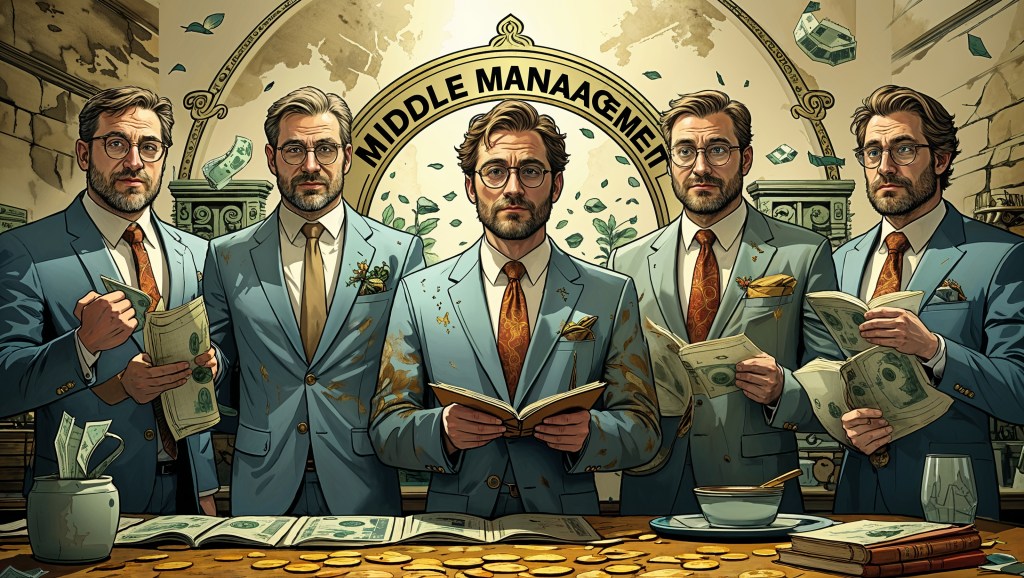
The Myth of the Busy Manager
There’s a certain breed of person you meet in every company. They’re not technical. They’re not particularly organised. They don’t create anything. But somehow, they’ve ended up in a role where they sit directly between the people who do the actual work and the ones pretending to make important decisions.
They’ve always got back-to-back calls. Their calendars are so full you’d think they were running a Fortune 500 company, not sitting in on three standups a day asking people what they’re working on. They spend most of their time booking meetings no one wants and sending out Slack messages that say “just checking in on this” like it’s a personality trait.
I remember one in particular who genuinely believed their job was to take notes and forward them to other people. Ask them about the actual system we were building and you’d get the digital equivalent of a shrug. It was like working with a human placeholder.
The Disappearing Act
What middle managers are really good at is disappearing when it matters.
Raise a concern and you’ll hear “let me escalate that” followed by three weeks of silence. Then, when the problem explodes in everyone’s face, they’ll magically reappear asking why they weren’t kept in the loop.
They don’t build anything. They don’t fix anything. They just linger long enough to have their name attached to the success and then ghost you when things go sideways. They’re basically WiFi signals — always dropping out when you actually need them.
And yet somehow, these people survive.
Not only do they survive, they thrive. I’ve watched them get promoted while actual contributors were left chasing vague promises about “career development plans” and “next quarter opportunities.”
One guy I worked with literally walked out of a surprise meeting grinning from ear to ear. The rest of us were wondering what happened until an announcement dropped congratulating him on his promotion. Meanwhile, I got pulled into a separate meeting and told they were “working on a plan for me.” That plan never arrived.
The Masters of Looking Busy
It’s a real skill, looking busy while doing absolutely nothing. These people have mastered it.
They jump into meetings, repeat what the last person said in a slightly more strategic tone, and then vanish again. They never get too involved. They never take real ownership. But they always make sure to be present just enough to look like they’re essential.
At another job, the “senior” engineer I worked with clearly had no idea how the system worked, even though they apparently built it. Their code was riddled with rookie errors and bad practices, but they were incredible at talking. They could waffle their way through any meeting, saying nothing of value, but always sounding confident. It didn’t matter that they couldn’t solve a basic problem. They had mastered the illusion of competence — and in most workplaces, that’s all you really need.
These aren’t isolated incidents. This is the system. This is how people fail upwards.
The Moral
I used to think titles meant something. That getting promoted was a sign of value. That being a senior, a lead, or a principal actually meant you knew what you were doing.
Now I know better.
Promotions often go to the people who play the game, not the ones doing the work. The loudest voices, not the smartest. The ones who know how to be visible, not useful.
So I stopped caring. I don’t care if you’re the CEO or the janitor. If you bring value, I’ll respect you. If you don’t, I won’t.
The corporate world is a circus. And middle management? They’re the ringmasters of nothing. They wave their arms, make a lot of noise, and somehow convince everyone there’s a show happening — even when the tent’s on fire.
You said:
More witty, more real, more insults
ChatGPT said:
Middle Management: The Career Path for People Who Failed Upwards
The Myth of the Full Calendar
There’s always one. The manager whose calendar looks like a Tetris board, packed with “strategy syncs” and “cross-team alignment sessions” that achieve absolutely nothing. They strut around like their time is worth gold, but when you actually speak to them, it becomes painfully clear — they have no idea what’s going on.
They don’t code, they don’t design, they don’t sell, they don’t even really manage. Their real skill is being present in meetings just long enough to say “thanks everyone, great input,” before vanishing to their next pointless check-in. Ask them a question that requires a real answer, and you’ll get a vague non-response peppered with buzzwords and panic behind the eyes.
They’re the corporate version of a magician — except instead of pulling rabbits out of hats, they just disappear whenever accountability enters the room.
The Spineless Chameleons of the Office Jungle
These people are experts at blending in. When leadership’s around, they’re strategic thinkers. When developers are venting, they’re on your side — silently, of course. And when everything blows up, they’re just as surprised as you are.
I once worked under a middle manager who, to this day, I’m convinced thought Git was a type of sandwich. They’d smile, nod, and say things like “let’s circle back” or “we’ll park that” while avoiding every concrete decision like it was a live grenade.
They’d ghost you for days, ignore your blockers, then pop up a week later asking why things aren’t done yet. Then they’d casually throw you under the bus in the next leadership call to “set expectations.” This person could’ve written a dissertation on how to do nothing while staying in the spotlight. They were a human LinkedIn post — all fluff, no substance.
When Talking Becomes a Survival Strategy
The real corporate currency isn’t skill, it’s sounding like you have it. And middle managers have that down to an art form.
They say things like “we need to align our delivery cadence with stakeholder expectations” — translation: I have no clue what’s happening but please don’t ask me to do anything.
One senior I worked with had clearly never touched the system they were supposedly in charge of. Their pull requests looked like they’d been written with their eyes closed. But they’d stroll into every meeting, drop a few big words, say “from a high-level perspective” a few times, and suddenly they’re seen as the brains of the operation. Meanwhile, we’re all silently praying they don’t touch the code again.
These people don’t climb the ladder. They squeeze themselves into the gap between rungs, holding on with ego, buzzwords, and sheer audacity.
The Moral (and the Meltdown)
At some point I stopped being surprised. I’ve been passed over for promotions by people whose biggest weekly achievement was forwarding an email chain. I’ve worked under seniors who couldn’t explain their own architecture diagrams. I’ve sat in meetings where middle managers spent 45 minutes saying nothing and still somehow walked away with praise.
The truth is this: titles are a joke. “Senior,” “Lead,” “Director,” “VP” — none of it means anything unless you’ve actually earned the respect of the people doing the work.
So no, I don’t care what your title is. I don’t care how many all-hands meetings you smile through or how many LinkedIn posts you write about “servant leadership.” If you’re not helping, you’re in the way.
Middle managers aren’t leaders. They’re just professional bystanders in branded fleeces. And while the rest of us are trying to ship things, fix things, or survive another week of absolute chaos, they’re out here perfecting their talent for doing sweet fuck all — and somehow getting paid handsomely for it.
The circus is real. The clowns are in charge. And middle management? They’re the ones handing out popcorn while the tent burns.
 The Toxic Boss
Leave a comment